Mosque Sound System Design: Clear Speech in Large Halls
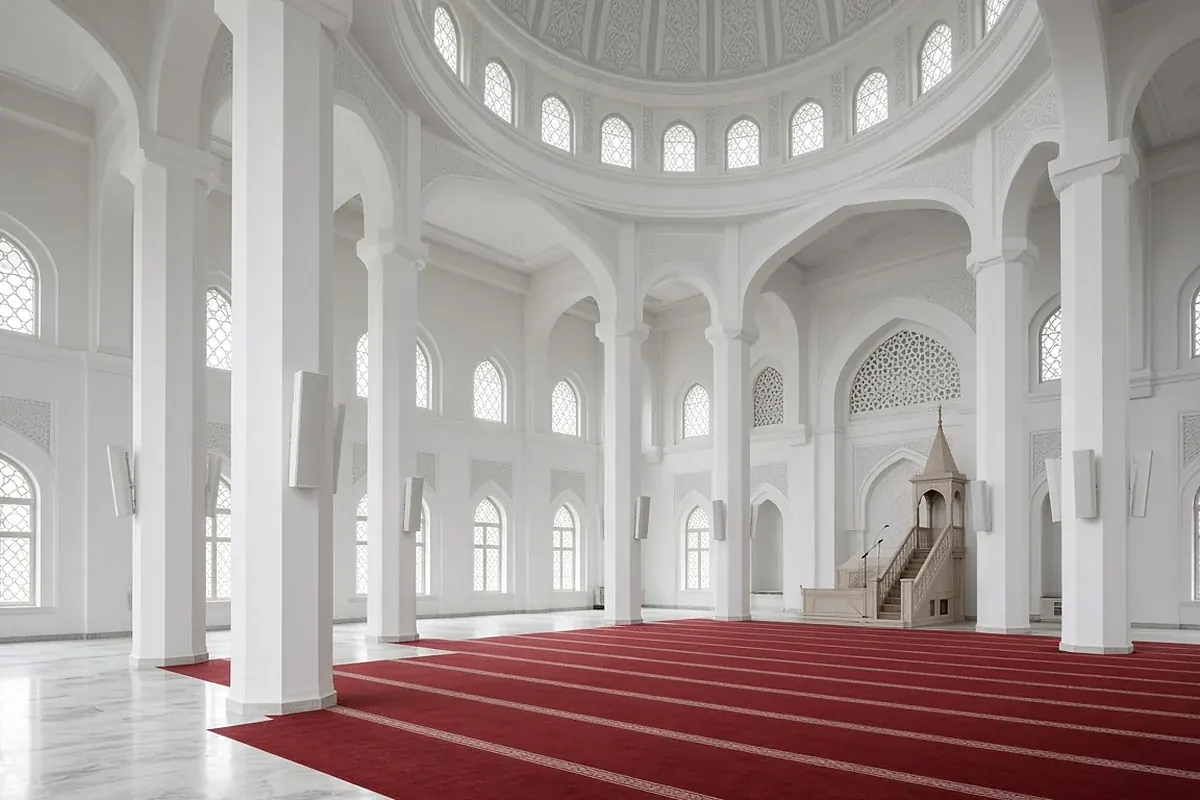
How to design a mosque sound system with clear speech under domes and on marble: steerable column speakers, Azaan, Khutbah zones and backup power.
Few buildings are as acoustically challenging as a mosque. A large prayer hall with a high dome, marble floors, plastered walls and very little soft furnishing can hold sound for a long time after a word is spoken. When the congregation is small, the hall feels peaceful. When the sound system is wrong, the Khutbah turns into a wash of echoes and worshippers at the back cannot follow a single sentence. This guide explains how to design a mosque sound system that delivers clear, natural speech in the main hall, the courtyard and the overflow areas, and that keeps working through load shedding.
The same principles apply to Imambargahs, churches, temples and large community halls, wherever speech must be understood in a large, reflective space.
Why mosques echo so much
Sound in a room reflects off every hard surface until it fades away. The time it takes to fade is called the reverberation time. Domes, marble, glazed tiles and parallel walls all reflect sound strongly, and a dome can also focus reflections onto particular spots on the floor. The result is a long, uneven reverberation that blurs speech, because each new syllable arrives while the previous one is still echoing.
The most common mistake is to fight echo with more loudspeakers and more volume. That excites the room even more and makes speech less clear. The goal is the opposite: put sound only where people are, and keep it off the walls and dome as much as possible.
Start with a survey and clear goals
- Spaces: main prayer hall, upper gallery, courtyard, ablution areas, madrassa classrooms and any overflow halls used for Jumu'ah and Eid.
- Sources: Azaan, the Imam's recitation in prayer, the Khutbah, Dars and Quran classes, and announcements.
- Measurements: room dimensions, dome height, background noise from fans and air conditioning, and if possible a measurement of reverberation time.
- Constraints: architectural finishes that cannot be changed, columns that limit loudspeaker positions, and local regulations on external loudspeakers.
The design target should be speech intelligibility, which acousticians measure with the Speech Transmission Index (STI). A good system aims for clear intelligibility at every prayer row, not just near the mihrab.
Loudspeakers: steerable column arrays
For large reverberant halls, digitally steerable column loudspeakers are usually the most effective solution. They look like slim vertical columns and can be finished to match the walls or pillars. Inside, a row of small drivers is controlled by a DSP so that the sound beam can be aimed precisely at the listening area and shaped to cover the floor from front to back, while sending very little energy to the dome and ceiling. Makers such as Renkus-Heinz, Bose Professional and Fohhn offer steerable columns designed for this kind of space.
Benefits in a mosque include:
- More direct sound reaching worshippers and less reflected sound from the dome.
- Even coverage from the front row to the back row.
- Discreet columns that suit traditional and modern architecture.
- Beam settings that can be adjusted after installation without moving the loudspeaker.
Distributed and delayed loudspeakers
In long halls, galleries and under low ceilings, additional small loudspeakers fill areas the main columns cannot reach. These must be time aligned with digital delay, so the sound from the nearest loudspeaker arrives just after the natural sound from the front. Without delay, worshippers hear the same word twice and clarity drops.
Courtyards, outdoor areas and the minaret
Outdoor loudspeakers for the courtyard and overflow areas should be weatherproof and rated for heat and dust. For the Azaan, horn loudspeakers on the minaret have traditionally been used. Choose quality, weather sealed units and aim them carefully, so the Azaan is clear without excessive level in nearby streets. Local regulations in several provinces restrict the use of external loudspeakers, so confirm what is permitted with the mosque committee and local administration before designing the outdoor system.
Microphones and the Imam position
- Mihrab: a discreet gooseneck or boundary microphone for the Imam during prayer.
- Minbar: a gooseneck microphone for the Khutbah, positioned so the Khateeb can turn without falling off the microphone.
- Wireless: a lapel or handheld wireless microphone for lectures and events, with frequencies chosen to avoid interference.
- Muezzin: a dedicated microphone and channel for the Azaan, routed to the minaret and courtyard zones.
Processing and control
A DSP sits at the heart of a modern mosque system. It handles equalisation, feedback suppression, delay for distributed loudspeakers, zoning and automatic gain so that a soft voice and a strong recitation both sound natural. A simple wall panel or preset buttons let the mosque staff choose scenes such as Azaan, Salah, Jumu'ah or Dars without touching the mixer. Lock the settings so well meaning volunteers cannot change them.
Zoning is important. The Azaan may go to the minaret, courtyard and all halls, while a Dars in the madrassa should stay in that room.
Acoustic treatment that respects the architecture
Where possible, combine the sound system with modest acoustic treatment. Carpets already help at floor level. Acoustic plaster, perforated wooden panels with absorbent backing and treatment on the rear wall can reduce echo significantly while blending with Islamic geometric design. Even a small amount of treatment on the right surfaces makes the sound system's job much easier.
Power backup and reliability
Prayer times do not move for load shedding. Put the DSP, amplifiers, wireless receivers and control panel on a UPS sized for the system, so the Azaan and Salah continue through power cuts and generator changeovers. Use surge protection, a dedicated circuit and good earthing, and keep amplifier racks in a ventilated, dust protected room. Networked amplifiers with monitoring can alert the caretaker if a loudspeaker line fails.
Commissioning and care
After installation, the system should be tuned with measurement tools in the empty hall and checked again during a full congregation, because people absorb sound and change the room. Train the caretaker and Muezzin on daily operation, label every control, and schedule periodic checks of microphones, batteries and outdoor loudspeakers.
Frequently asked questions
Why does our mosque sound unclear even though it is loud?
Because the hall is reverberant and the loudspeakers are sending sound to the dome and walls. More volume adds more echo. Steerable column loudspeakers and correct delay usually improve clarity far more than extra power.
What are steerable column loudspeakers?
Slim vertical loudspeakers with many drivers controlled by a DSP. Their sound beam can be aimed at the congregation and away from reflective surfaces.
Can the Azaan be sent to the minaret only?
Yes. With zoning in the DSP, the Azaan can be routed to the minaret, courtyard and halls as required, while other sessions stay inside.
Do we need acoustic treatment as well as a new system?
Not always, but modest treatment on key surfaces makes a big difference in very reverberant halls, and it can be designed to suit the architecture.
How do we keep the system running during load shedding?
Use a properly sized UPS for the processing, amplifiers and wireless microphones, plus surge protection and good earthing.
Can the same system serve the madrassa classes?
Yes. A zoned system can feed classrooms separately, with their own microphones and volume, so classes do not disturb the main hall.
Get a clearer sound in your mosque
Media K Solutions designs audio-visual and sound systems for public meeting spaces, halls and institutions across Pakistan, with the cabling and power infrastructure to support them.
Speak to Media K Solutions: call or WhatsApp +92 300 846 7101, or email info@mediaksolutions.com.
Planning a project? Call +92 300 846 7101, email info@mediaksolutions.com or request a quote.